 RCRAReady
Compliance 12 min read
6 Most Common RCRA Violations: What EPA Inspectors Cite First
Open containers, missed inspection logs, overdue deadlines: these are the violations EPA finds in the first 30 minutes. Here's what triggers each citation and how to close the gaps.
On this page
The most common RCRA violations are usually not dramatic spills or illegal dumping cases. They are routine hazardous waste compliance failures EPA inspectors can verify quickly: a missing accumulation date, an open container, a missed weekly inspection, overdue manifest follow-up, or a waste determination that was never documented.
This guide uses the federal RCRA generator rules as the baseline. Many states are authorized to run their own hazardous waste programs, and they can be more stringent than the federal rules, so always confirm the state-specific requirement that applies to your facility.
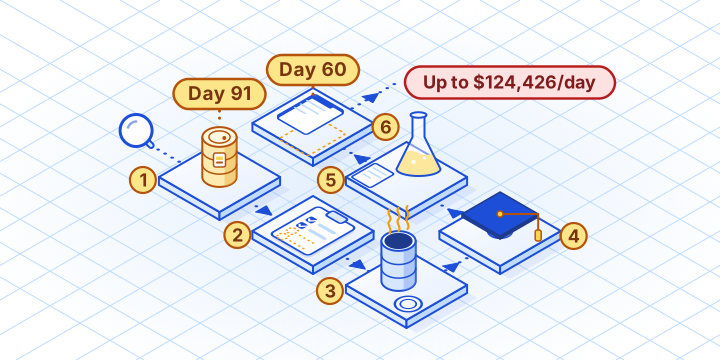
That matters because Subtitle C civil penalties under RCRA now reach $124,426 per day, per violation under § 3008(a)(3) as of January 8, 2025. A drum without a date, a missed inspection entry, an expired training record, or an untracked manifest can become a serious liability event when the proof is missing.
Violation #1: Storage Time Limit Violations (The 90/180-Day Rule)
Regulatory basis: LQG accumulation conditions, SQG accumulation conditions
This is the single most costly and most preventable violation category. Large Quantity Generators must ship all hazardous waste off-site within 90 days. Small Quantity Generators have 180 days (or 270 days if the TSDF is more than 200 miles away).
A Day 91 container can push an LQG out of its accumulation exemption and into storage-facility exposure unless EPA grants a short extension under the rule. That carries a completely different legal and financial exposure profile.
Why It Keeps Happening
The mechanism of failure is almost always the same: the tracking method doesn’t keep up with the physical reality of the storage area.
- A container is moved from a satellite area to the central accumulation area, but the date is never updated to reflect when it entered the CAA.
- A container label is written retroactively — when the drum was full rather than when the first waste was added.
- A weekly walk-through is skipped because the usual person is out, and a container that was on day 82 passes unnoticed until day 94.
- Multiple drums are being tracked across a shared spreadsheet, a whiteboard, and a paper log simultaneously — and no single person has full visibility.
Inspectors do not require admission of negligence to issue a citation. They compare the date on the label to the date of the inspection. That’s the entire evidentiary chain.
The Cost
At $124,426 per day, a drum found 30 days over its limit represents a theoretical exposure of $3.73 million. Actual enforcement settlements are typically lower, but the EPA’s RCRA civil penalty policy specifically accounts for the economic benefit gained from delayed disposal. If delaying shipment saved the facility $10,000 in hauling costs, that benefit can be added to the base penalty.
Tool Tip: See what facilities have actually paid in our RCRA Penalty Explorer, which covers EPA and state penalties since 2015.
Prevention control: Keep one live container inventory with the accumulation start date, generator category, day count, assigned owner, and next shipment action. Alerts at day 60, 75, and 85 help, but only if the source record is created when the container enters the CAA, not when someone has time to update a spreadsheet later.
Violation #2: Failure to Document Weekly Inspections
Regulatory basis: SQG weekly container inspections, LQG weekly CAA inspections
Both SQGs and LQGs are required to inspect central accumulation areas at least weekly. The federal container rules specifically call out leaks and container deterioration; in practice, a defensible inspection record should also make open lids, aisle blockages, and approaching accumulation deadlines visible. A useful written log includes:
- Date and time of the inspection
- Name of the inspector
- Observations made (including “no issues found”)
- Any corrective actions taken
The critical point most EHS teams miss: The inspection has to be provable, not just performed. An inspector does not care whether the walk-through happened in someone’s memory — they can only see what was written down. A facility that inspected every single week but logged nothing has very little audit defense.
Why It Keeps Happening
Inspections get logged inconsistently because they depend entirely on a specific individual remembering to complete a paper form or spreadsheet row. When that person is sick, on vacation, responding to a safety incident, or simply overwhelmed, the record does not get made. When documentation is stored in a binder that lives in one office, there is no visibility into whether this week’s entry exists until someone physically checks.
This is the second most cited RCRA violation category — not because facilities aren’t inspecting, but because the documentation is missing, incomplete, or stored in a format that can’t survive an audit.
Prevention control: Make the weekly inspection record easy to complete at the point of inspection, with required fields for date, time, inspector, observations, and corrective actions. The team should know an entry is missing before the next inspection window starts, not during an audit.
Violation #3: Open or Improperly Labeled Containers
Regulatory basis: satellite container closure, SQG CAA container closure, LQG CAA container closure
Containers must be closed at all times, except when waste is actively being added or removed. EPA’s generator FAQ explains how it thinks about a “closed” container: lids, rings, bungs, and openings need to be properly secured for the container type. There is no allowance for “almost closed,” “resting on top,” or “the bung is in but not torqued.”
Required label elements for CAA containers are similar for SQGs and LQGs: the words “Hazardous Waste,” an indication of the hazards, and the accumulation start date. Before off-site shipment, generators must also mark applicable EPA hazardous waste codes.
| Element | What’s Required | What’s Often Missing |
|---|---|---|
| “Hazardous Waste” | Verbatim — no abbreviations | “HW,” “Haz Waste,” coded stickers |
| Hazard indication | Flammable, corrosive, toxic, reactive, etc. | Left blank, or “mixed” |
| Accumulation start date | The day the accumulation period begins | Written when full; left blank pending paperwork |
| EPA waste codes before shipment | All applicable EPA hazardous waste numbers | Listing only a nickname or internal code |
Why It Keeps Happening
Open containers occur because of cultural drift — the rule is known, but in a busy operations environment, a funnel gets left in a bung, a lid gets rested rather than torqued, and nobody says anything until the inspector does. Labeling errors occur because labels are filled out at the wrong time or by people who weren’t trained on the specific requirements.
These violations are remarkably easy to issue. An inspector doesn’t need to analyze samples or review records — they can cite an open container within the first 30 seconds of walking into a storage room.
Prevention control: Treat closure and labeling as gate checks, not cleanup tasks. If a container is active, the team should be able to confirm closure status, hazard indication, accumulation start date, and waste-code status before the container is considered ready for storage or shipment.
Violation #4: Inadequate Employee Training Records
Regulatory basis: LQG personnel training, SQG emergency-procedure familiarity
LQGs face the most rigorous training requirements in the generator world. All personnel whose work could cause or prevent RCRA non-compliance must:
- Complete an initial training program within 6 months of hire or assignment to a new position
- Complete an annual review of the initial training — the anniversary clock is per-employee, not facility-wide
- Be supervised by a trained employee until initial training is complete
The required training documentation includes:
- Job title and name for every position with hazardous waste responsibilities
- Written job description for each position
- Written description of the training program content
- Records documenting that required training or job experience has been completed
Records must be maintained for current employees until facility closure and for at least 3 years after a former employee’s last day.
Why This Is a Systemic Failure
Training records are typically maintained in HR systems that EHS managers don’t control, spreadsheets that go stale, or paper folders in a filing cabinet. When an employee changes roles, leaves the company, or is hired mid-year, their record often falls through the cracks. Annual refresher dates drift. Contractors who manage waste on-site are overlooked entirely.
During an inspection, an EPA auditor will request training records for every employee who handles waste. A missing entry for a single employee is a violation. A missing entry for twelve employees, or missing annual refreshers across the team, is a pattern — and pattern violations receive significantly less enforcement discretion.
Prevention control: Maintain a training roster owned by EHS, not only HR. Track each employee’s role, job description, initial training due date, annual review date, and proof that required training or job experience was completed.
Violation #5: Incorrect Hazardous Waste Determinations
Regulatory basis: hazardous waste determination and recordkeeping
Before any waste can be managed under RCRA, a generator must first determine whether it is actually a RCRA hazardous waste. This “hazardous waste determination” must be made for every solid waste the facility produces, and SQGs and LQGs must keep supporting records.
A waste is hazardous if it:
- Appears on one of the EPA’s listed hazardous waste categories (F-list, K-list, P-list, U-list), or
- Exhibits one or more hazardous characteristics: ignitability (D001), corrosivity (D002), reactivity (D003), or toxicity (D004-D043)
The determination must be made using either process knowledge (documentation of the materials and processes that generated the waste) or laboratory testing when available knowledge is inadequate. Verbal knowledge, assumptions, or historical memory are not compliant substitutes for documented process knowledge.
Common Failure Modes
- A facility changes a chemical process and generates a new waste stream. Nobody triggers a new determination because the waste “looks the same.”
- An expired product is discarded without checking whether the commercial chemical falls on the P-list or U-list.
- A waste stream is classified based on a determination from 1998 that has never been reviewed since the formulation changed.
- Mixed waste streams are characterized based on the dominant component, ignoring that a minor component is a listed hazardous waste that can trigger the mixture rule.
An incorrect waste determination is not just a paperwork violation — it is the gateway to either under-managing waste (an environmental crime) or over-managing it (a wasted expense). Either way, it suggests the facility’s compliance system fundamentally lacks the visibility to identify new hazards as they arise.
Prevention control: Trigger a new or updated waste determination whenever a process, formulation, feedstock, cleaning method, or disposal path changes. Keep the supporting evidence together: SDSs, lab results, process-knowledge notes, and the listed/characteristic rationale.
Violation #6: Manifest and Recordkeeping Failures
Regulatory basis: manifest recordkeeping, exception reporting
Generators must retain copies of hazardous waste manifests for at least 3 years. But retention is only half the obligation — active monitoring is the other half.
For the form, the signatures, and the retention rules, see the hazardous waste manifest guide.
The Exception Reporting Timeline
After waste leaves your facility, your liability doesn’t. Once your transporter accepts the waste, a chain of return-copy deadlines begins:
For LQGs:
- Day 45: If no signed manifest copy has been received, you must contact the transporter and/or designated facility to determine the status of the waste.
- Day 60: If still not received, you must file a formal Exception Report electronically via RCRAInfo e-Manifest.
For SQGs:
- Day 60: If no signed manifest copy has been received, you must file a formal Exception Report electronically via RCRAInfo e-Manifest. (Single-step — no intermediate contact requirement.)
Since December 1, 2025, paper Exception Reports are no longer accepted by the EPA for LQGs and SQGs. EPA says these reports must be submitted through the RCRAInfo e-Manifest portal, and the current regulation now points LQGs and SQGs to the e-Manifest system. A facility that files a paper report — or misses the deadline entirely because nobody was tracking the return clock — is in violation.
Why This Fails at Scale
A facility managing 20 active waste shipments at any time has 20 separate manifest return clocks running simultaneously. Each one starts on a different date. The 45-day inquiry window for LQGs falls on a different calendar day for every shipment. Without a system designed to track each shipment individually, the only options are a manual spreadsheet that requires weekly human reconciliation, or no tracking at all.
The final manifest record may appear in e-Manifest or arrive through a paper workflow, but the failure mode is the same: it gets filed, buried, or never checked off against the master shipment log. The EHS coordinator only notices it’s missing when conducting a compliance review — long after the 45- or 60-day window has closed.
Prevention control: Treat every manifest as its own return-copy clock. Record the transporter acceptance date, expected final manifest receipt, the LQG day-45 inquiry deadline, the day-60 exception-report deadline, and the person responsible for closing the loop.
Why These Violations Keep Happening: The Root Cause
Every violation in this list shares the same underlying root cause: compliance is invisible until it fails.
Manual systems — whiteboards, spreadsheets, paper logs, email reminders — require constant human attention and perfect execution across every shift, every week, every quarter: Storage deadlines accumulate silently. Inspection logs need someone to remember. Training anniversaries drift. Return manifests get buried in mail.
This is not a failure of competence or diligence. It is a structural problem: manual systems cannot simultaneously monitor dozens of independent compliance clocks without introducing human error as a routine variable. And in a regulatory environment where a single missed entry can trigger a five-figure daily fine, “almost always correct” is not a viable compliance strategy.
2026 Regulatory Roadmap: Two Emerging Risks to Watch
Beyond the persistent top violations, EHS managers should be tracking two developing regulatory shifts in 2026:
1. PFAS as Hazardous Constituents The EPA has proposed listing nine PFAS compounds — including PFOA and PFOS — as RCRA hazardous constituents. While this initial step does not immediately create new listed hazardous waste codes for generators, it signals a regulatory trajectory that will expand PFAS-related tracking requirements. Facilities that handle PFAS-containing solvents, firefighting foams, or industrial process chemicals should begin documenting their PFAS waste streams now, before a new listing forces retroactive compliance.
2. Lithium Battery Waste Management EPA is developing a rulemaking that would establish a distinct universal waste category for lithium batteries with tailored safety and storage standards. As lithium battery use scales across manufacturing, distribution, and logistics operations, facilities that accumulate spent battery packs should expect sharper tracking, labeling, and storage expectations. Treating lithium batteries as standard universal waste today may not be sufficient after the final rule is published.
Regulatory Sources & References
- Official Citation: 40 CFR § 262.11 - Hazardous waste determination
- Official Citation: 40 CFR § 262.15 - Satellite accumulation area regulations
- Official Citation: 40 CFR § 262.16 - Conditions for exemption for an SQG
- Official Citation: 40 CFR § 262.17 - Conditions for exemption for an LQG
- Official Citation: 40 CFR § 262.40 - Recordkeeping
- Official Citation: 40 CFR § 262.42 - Exception reporting
- Official Citation: 40 CFR § 19.4 - Civil monetary penalty inflation adjustments
- EPA Guidance: EPA e-Manifest FAQs
- EPA Guidance: RCRA Hazardous Waste Generators Overview
- EPA Guidance: Frequent Questions About Hazardous Waste Generation
- EPA Guidance: Hazardous Waste Generator Improvements Rule Summary
Frequently asked questions
What are the most common RCRA violations found during EPA inspections?
The most frequently cited RCRA violations include: exceeding on-site storage time limits (90 days for LQGs, 180 days for SQGs), failure to document weekly inspections, open or improperly labeled containers, inadequate or missing employee training records, incorrect hazardous waste determinations, and manifest recordkeeping errors.
What is the 45/60-day manifest exception-reporting rule for LQGs?
Under 40 CFR 262.42, if an LQG does not receive a signed manifest copy from the TSDF within 45 days of the waste being accepted by the initial transporter, it must contact the transporter and TSDF. If the signed copy is still not received by 60 days, the LQG must file a formal Exception Report electronically via RCRAInfo e-Manifest.
Does the EPA accept paper Exception Reports in 2026?
No for LQGs and SQGs. As of December 1, 2025, the EPA requires Exception Reports, Discrepancy Reports, and Unmanifested Waste Reports to be submitted electronically via the RCRAInfo e-Manifest portal. Paper submissions are no longer accepted for those generators. LQGs and SQGs must be registered in RCRAInfo to comply.
What counts as a RCRA training violation?
LQGs violate 40 CFR 262.17(a)(7) if they: fail to provide initial training within 6 months of hire, fail to conduct annual refresher training, cannot produce written job descriptions for each hazardous waste position, or lack records documenting that each employee completed required training. The records must be kept for current employees until facility closure and for 3 years after an employee leaves.
Can I be fined for an open hazardous waste container?
Yes. RCRA regulations under 40 CFR 262.15, 262.16, and 262.17 require hazardous waste containers to remain closed at all times except when waste is actively being added or removed. An unsecured lid, even if resting on a drum, qualifies as an 'open container' during an inspection. Each open container is a separate violation.
What is a hazardous waste determination, and why does it matter?
Under 40 CFR 262.11, generators must determine whether each solid waste they produce is a RCRA hazardous waste before managing it. This is called a 'hazardous waste determination.' Failure to characterize a waste stream — even if the waste is ultimately managed correctly — is itself a violation. Common failures include not testing waste streams, not consulting the EPA hazardous waste lists (F, K, P, U lists), or not documenting the determination process.
What happens if a facility fails to perform weekly inspections?
Failing to perform weekly inspections of hazardous waste storage areas, or failing to produce contemporaneous records showing they occurred, is one of the most cited RCRA inspection findings. Weekly container inspections are required under 40 CFR 262.16(b)(2)(iv) for SQGs and 262.17(a)(1)(v) for LQGs. Without a contemporaneous written record, the facility has very little audit defense.
What is the penalty for missing hazardous waste manifest records?
Generators must retain copies of all manifests for at least 3 years under 40 CFR 262.40. Failure to produce a manifest during an inspection, failure to track return copies from the TSDF, or failure to file Exception Reports on time are all enforceable violations carrying penalties up to $124,426 per day as of January 8, 2025.
What are the new PFAS rules generators need to know about in 2026?
The EPA has proposed adding nine PFAS compounds (including PFOA and PFOS) as RCRA hazardous constituents. While not yet classified as listed hazardous wastes that directly trigger generator cradle-to-grave requirements, this rulemaking is expected to create new corrective action obligations at TSDFs and may eventually expand generator tracking and reporting requirements for PFAS-containing waste streams.