 RCRAReady
RCRA Violation Recidivism in EPA Data: Prior Violations Predict Higher Repeat-Citation Rates
EPA RCRAInfo facility, inspection, violation, and VIOSNC history data, with a 21,560-facility two-window recidivism cohort.
Key Findings
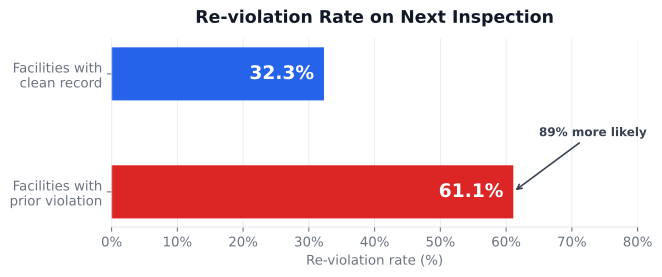
- →Facilities cited for a RCRA violation were 89% more likely to be cited again on their next inspection (61.1% vs 32.3%).
- →5,705 facilities accumulated 20 or more lifetime violations, showing a meaningful chronic-offender tail in the regulated population.
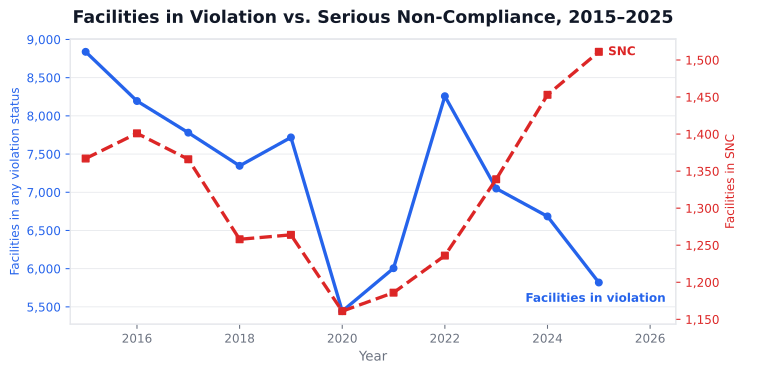
- →Serious Non-Compliance reached 1,511 facilities in 2025, up about 30% from the 2020 low of 1,161, even while total facilities in violation trended down.
- →Median time to close a violation was 73 days, but the 90th percentile stretched to 617 days, suggesting many facilities fix the cited item slowly or incompletely.
What the data shows
Facilities with prior RCRA violations are materially more likely to be cited again on subsequent inspections. In an analysis of 701,715 EPA RCRA violation records and 21,560 facilities observed across two inspection windows, facilities with a prior violation had a 61.1% re-violation rate on their next inspection, compared with 32.3% for facilities that began with a clean record.
The gap is large enough to suggest that many RCRA violations are not isolated events. In a meaningful share of facilities, they appear to reflect persistent weaknesses in the underlying compliance system rather than one-time lapses.
The recidivism numbers
To evaluate this pattern, we identified facilities that were inspected between 2014 and 2018 and then re-inspected between 2019 and 2023, giving a clean five-year follow-up window. We then compared later inspection outcomes for two groups: facilities that had a violation found in the first window, and facilities with a clean record in the first window.
Among facilities with a prior violation, 61.1% were cited again on their next inspection. Among facilities with a clean first-window record, the rate was 32.3%. Prior violation status made a facility 89% more likely to re-offend.
The pattern is steeper for large generators
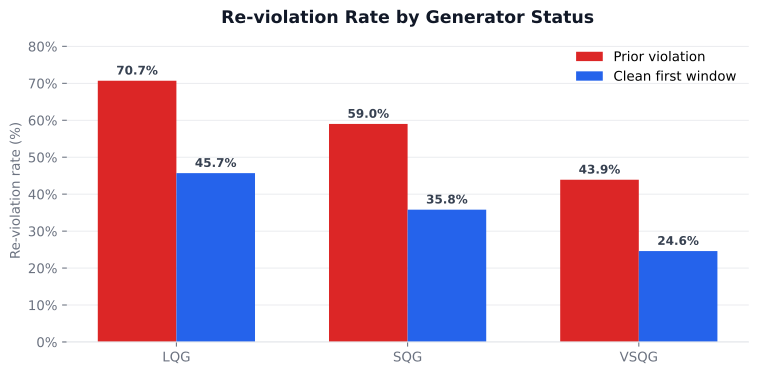
The aggregate result holds across generator categories, but the gradient is strongest for larger generators. Among facilities classified as Large Quantity Generators in the cohort, 70.7% of those with a prior violation were cited again, compared with 45.7% of those that started clean. For Small Quantity Generators, the same comparison was 59.0% versus 35.8%. For Very Small Quantity Generators, it was 43.9% versus 24.6%.
That step-down matters. It suggests the recidivism pattern is not just a generic artifact of inspections. It scales with operational complexity, which is exactly what you would expect if repeat violations are tied to the difficulty of sustaining container, manifest, and recordkeeping controls over time.
The chronic offender tail
The aggregate recidivism rate understates the problem at the tail. While most facilities that ever violated did so once or a small number of times, a meaningful portion have accumulated violations across decades of inspections.
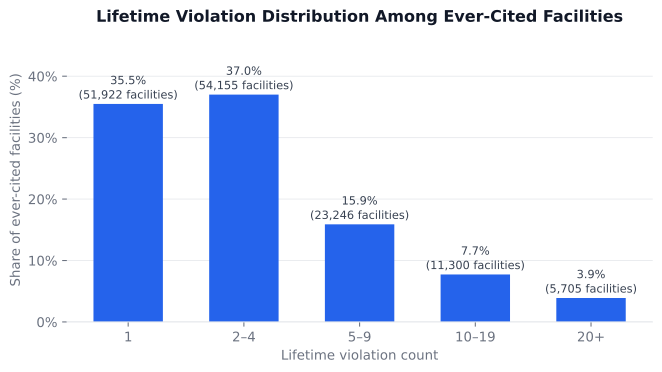
Among the 146,328 facilities ever cited in the RCRA database, 37.0% were cited between 2 and 4 times. Nearly 4% accumulated 20 or more lifetime violations. That is 5,705 facilities generating repeated citations across multiple inspections and regulatory cycles.
Some cases span decades. One facility in Illinois has a violation on record from 1985 that remains administratively open. Another in Michigan carries 68 open violations dating to 2019. These are not anomalies in an otherwise tidy system. They represent the hard end of a distribution that is wider than the headline numbers suggest.
More importantly, the tail is not just a curiosity. It carries a disproportionate share of the total enforcement burden. Facilities with 20 or more lifetime violations account for only 3.9% of ever-cited facilities, but they account for 29.1% of all violation records in the dataset. Expand that lens to facilities with 10 or more lifetime violations, and the share rises to 50.6% of all recorded violations. A relatively small slice of the regulated universe is generating a very large share of the total problem.
The compliance landscape is bifurcating
The aggregate trend in RCRA violations looks encouraging on the surface: total violation counts have declined over the past decade. But a closer look at the Significant Non-Compliance data tells a more complicated story.
SNC designations, which flag the most serious or persistent non-compliance cases, reached 1,511 facilities in 2025, the highest annual count in the file we analyzed and about 30% above the 2020 low of 1,161. At the same time, total facilities in violation are down from their mid-2010s levels. The compliance landscape appears to be splitting into two groups: facilities that are getting cleaner over time, and a smaller but growing set of facilities in deep, sustained non-compliance that standard enforcement is not resolving.
Repeat violations usually cluster in the same rule families
If repeated violations were mostly random, you would expect the same facility to bounce across unrelated rule areas over time. That is not what the file shows. Among the 94,406 facilities with two or more recorded violations, the single most common violation-code family for each facility accounts for an average of 69.7% of its total violations. And 84.5% of multi-violation facilities have a majority of their violations concentrated in one rule-family prefix.
That does not prove the exact same fact pattern recurs every time. But it is strong evidence that repeat violators tend to fail in the same operational domain again and again: generator standards, pre-transport controls, recordkeeping and reporting, manifesting, or related rule sets. In practice, that looks much more like a persistent system weakness than a sequence of unrelated mistakes.
A possible explanation: systems, not intent
The violation record data identifies a strong correlation between prior violations and future violations. It does not establish cause. A critical reader might reasonably ask whether the pattern reflects facility size, inspection targeting, or industry sector rather than process quality. Those are legitimate questions this analysis does not fully answer.
That said, the patterns are consistent with a process explanation. Facilities that accumulate repeat violations across different inspection cycles tend to be cited for the same violation categories. This is not what you would expect if the problem were deliberate non-compliance or random operational error. It looks more like a facility that lacks the infrastructure to maintain compliance continuously across staff turnover and operational change.
Common RCRA compliance gaps, including missed accumulation deadlines, incomplete container labeling, and lapses in manifest recordkeeping, are fundamentally tracking problems. They require knowing the state of every container, every accumulation start date, and every open manifest at any given time. For facilities managing that in spreadsheets or on whiteboards, the margin for error is low and the recovery from a staffing change or operational disruption is slow.
The resolution time data is consistent with this. The median violation takes 73 days to close out. But 10% of violations remain open for more than 617 days. That long tail likely reflects cases where the underlying process gap was not addressed alongside the cited item.
Implications for compliance programs
The practical takeaway from the recidivism data is that a first citation should be treated as a signal about process, not just a specific regulatory item to resolve. Facilities that address only the cited violation without examining the underlying tracking and documentation system are likely to encounter the same or similar issues on the next inspection.
The SNC bifurcation finding reinforces this. The facilities accumulating serious non-compliance designations are not randomly distributed across the regulated universe. They are disproportionately facilities that have been in violation before. The compliance gap tends to compound rather than self-correct without a systematic intervention.
Methodology
This analysis is based on the EPA RCRAInfo bulk data download, accessed on April 14, 2026 and updated weekly by EPA. The dataset covers 1,585,767 facility records, 1,158,227 evaluation records, 701,715 violation records, and 2,656,778 VIOSNC history records.
Recidivism was measured by identifying facilities inspected in two non-overlapping five-year windows (2014-2018 and 2019-2023) and comparing the rate of violation found in the second window by prior-violation status in the first. Only facilities appearing in both windows were included. The analysis covers 21,560 facilities meeting these criteria.
Generator-status subgroup results use each facility's reported generator category and are shown only for categories with meaningful cohort size. The repeat-family analysis groups violations by regulatory rule family to test whether repeat findings cluster in the same compliance domain.
California and New York are EPA-authorized states whose inspection records are not fully reported into the federal RCRAInfo system. Facilities in these states are included in violation and facility counts but may be underrepresented in inspection-based analyses. SNC trend data uses the most recent monthly VIOSNC snapshot available for each facility-year and stops at 2025 to avoid comparing complete annual counts with the partial 2026 snapshot present in the source file.
As a basic robustness check, the recidivism gap remains visible when the cohort is sliced by evaluation agency and when restricted to Compliance Evaluation Inspections alone. Exact rates move slightly depending on how facilities with mixed first-window inspection histories are assigned to an agency or evaluation type bucket, but the underlying pattern does not change: facilities with prior violations remain materially more likely to be cited again than facilities that started clean.
Data source: EPA ECHO RCRAInfo Dataset.
If this report is useful, the most relevant follow-on resources are the Audit Readiness Assessment, the EPA Penalty Explorer, and our guide to common RCRA violations.
Frequently asked questions
Do RCRA violations usually repeat?
In this analysis, yes. Facilities with a prior violation had a 61.1% re-violation rate on their next inspection, versus 32.3% for facilities with a clean first-window record.
Does this research prove that a citation causes future violations?
No. The result is a strong correlation, not a causal proof. Facility size, inspection targeting, and sector mix may explain part of the gap, but the persistence of repeated findings still points to structural compliance-system weakness.
What is Significant Non-Compliance in this report?
SNC refers to the EPA's Serious Non-Compliance designation in the RCRAInfo VIOSNC history data. It flags facilities with more severe or persistent compliance problems than routine findings.
Why does the methodology call out California and New York?
Those are EPA-authorized states whose inspection activity is not fully represented in the federal RCRAInfo inspection records, so inspection-based comparisons likely undercount activity there.