 RCRAReady
Compliance 11 min read
RCRA 90-Day Rule: When the LQG Accumulation Clock Starts
Understand when the LQG 90-day clock starts, how satellite accumulation differs, what labels must show, and how to avoid overdue hazardous waste.
On this page
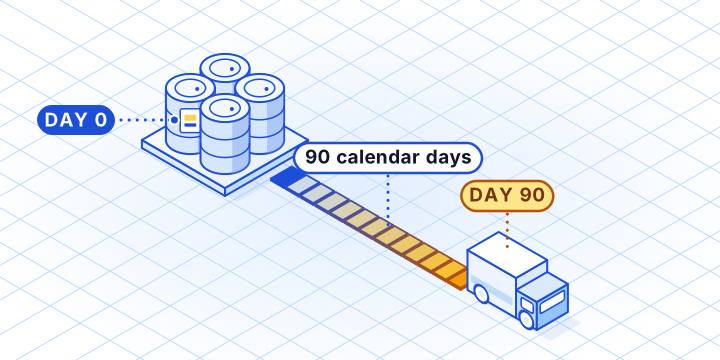
The RCRA 90-day rule requires Large Quantity Generators (LQGs) to clear hazardous waste from exempt accumulation within 90 calendar days of the accumulation start date in a Central Accumulation Area. For most generators, that means shipping the waste off-site before day 91. The harder compliance question is not the 90-day limit itself, but identifying the correct accumulation start date.
For waste first accumulated in a Central Accumulation Area, the 90-day clock starts when the first waste enters the container. For a container transferred from a compliant Satellite Accumulation Area (SAA), the clock starts on arrival in the CAA. Waiting for a drum to fill or for a pickup to be scheduled does not postpone its CAA start date.
This guide explains who the RCRA 90-day rule applies to, when the accumulation clock starts, how SAA and CAA timing differs, what must be on the label, when extensions are available, and what happens if you miss the deadline.
What is the RCRA 90-Day Rule?
Under the Resource Conservation and Recovery Act (RCRA) and the LQG accumulation rule, the EPA limits how long a Large Quantity Generator (LQG) can store hazardous waste on-site without a formal permit. The ordinary limit is 90 calendar days, provided all applicable conditions for the accumulation exemption are met. This guide focuses on containers; tanks, drip pads, and containment buildings have additional unit-specific rules. Special provisions, such as qualifying F006 waste sent for metals recovery, can allow longer accumulation periods.
If waste exceeds the applicable 90-day accumulation period without an approved extension or other applicable provision, the generator loses its storage exemption and becomes subject to the TSDF permitting and operating framework. Continued storage without the required authorization can lead to enforcement.
Important: The ordinary 90-day accumulation limit applies to LQGs. Small Quantity Generators (SQGs) generally have 180 days (or 270 days if the waste must be transported 200 miles or more for off-site treatment, storage, or disposal) under the SQG accumulation rules. If you’re unsure of your status, see our SQG vs. LQG Requirements guide.
State rules: This guide describes federal requirements. Check your authorized state program for stricter requirements and its adoption of federal generator rules.
Where and When Does the Clock Start?
A common source of confusion around the RCRA 90-day rule is the clock-start question. The answer depends on where the waste is managed when it is generated.
Central Accumulation Areas (CAA)
A Central Accumulation Area is an on-site hazardous waste accumulation area subject to the SQG or LQG accumulation rules. Examples include a drum storage room, chemical storage building, or designated outdoor pad. Its regulatory status depends on how waste is managed, not simply its distance from the point of generation.
For waste first accumulated in a CAA, the clock starts when the first waste enters the container. For waste arriving from a compliant SAA, use the CAA arrival date. Filling, moving, or labeling the container later does not reset that start date.
Common labeling issue: An operator fills a 55-gallon drum in a CAA over the course of two weeks. On week three, they write today’s date on the label. The date should reflect when CAA accumulation actually began. Using the later date understates the accumulation period and can violate the marking requirement.
The accumulation start date must be visibly marked on the container label on the day accumulation begins, not retroactively.
Satellite Accumulation Areas (SAA)
A Satellite Accumulation Area is a location at or near the point of waste generation — the bench where a solvent is used, the maintenance bay where hazardous spent solvent is collected, the lab bench where expired reagents are collected. SAAs allow small quantities of waste to be held at the point of generation under the direct control of the operator generating the waste.
Key rules for SAAs:
- SAA volume limits: up to 55 gallons of non-acute hazardous waste and/or either 1 quart of liquid acute hazardous waste or 1 kg of solid acute hazardous waste at or near a point of generation
- No federal accumulation time limit applies while all SAA conditions are met, including the quantity limits
- Must be at or near the point of generation
- Must be under the control of the operator of the process generating the waste
- Closed-container rule: keep containers closed except when adding, removing, or consolidating waste, or when temporary venting is necessary for equipment operation or to prevent a dangerous situation
- SAA label rule: containers must be labeled with the words “Hazardous Waste” and an indication of the hazards of the contents
What happens when the SAA volume limit is exceeded?
Exceeding the 55-gallon non-acute, 1-quart liquid acute, or 1-kg solid acute limit triggers an action deadline of 3 consecutive calendar days to:
- Transfer the excess to a compliant CAA, an on-site permitted or interim-status TSDF, or an off-site designated facility; or
- Begin complying with full CAA requirements for LQGs
Continue meeting the SAA container conditions during those three calendar days. Mark containers holding excess waste with the date the limit was exceeded. On transfer to a CAA, mark the CAA start date. EPA clarifies that this also applies to voluntary transfers before an SAA limit is exceeded. Moving waste late does not cure a missed three-day deadline.
Tool Tip: Use our RCRA Storage Deadline Calculator to calculate your exact 90-day (or 180-day) shipment deadline and get an instant countdown.
What Must Be on a Hazardous Waste Container Label?
Proper labeling is one of the main ways inspectors verify accumulation-time compliance. During an inspection, inspectors can check labels because they reveal the accumulation start date and the nature of the contents without requiring the EHS manager to present any records.
Under the federal CAA labeling rules for LQGs and SQGs, every hazardous waste container in a CAA must display the core federal label elements below. A contents or chemical-identity field is also a strong operational control and may be required by state rules or your facility label standard.
| Label Element | Requirement / Role | Common Error |
|---|---|---|
| “Hazardous Waste” | Must appear verbatim | Using “HW” or abbreviations |
| Indication of hazards | Hazard words or applicable DOT, OSHA, or NFPA hazard labels/pictograms | Leaving blank or writing “mixed waste” |
| Accumulation Start Date | The date the CAA accumulation period began | Writing the date the container was full, or leaving blank |
| Contents / waste identity | Best practice and state/program-dependent label field | Writing only a waste code when the program expects names |
Labels must be legible and must remain attached and readable throughout the accumulation period. Replace damaged labels when required information is missing or unreadable.
SAA Labeling
Under the SAA label rule, containers must be labeled with the words “Hazardous Waste” and an indication of the hazards of the contents. A contents description alone may not communicate the hazards. A CAA start date is not required while waste remains in a compliant SAA, but the date the volume limit was exceeded must be marked immediately once exceeded.
The 30-Day Extension: When and How to Request One
The 90-day limit is strict, but the EPA recognizes that genuine emergencies occur. The LQG extension provision allows an extension of up to 30 days from the EPA Regional Administrator (or authorized state agency) if the following conditions are met:
- The circumstances causing the delay must be unforeseen, temporary, and uncontrollable, meaning the generator could not have anticipated or prevented them.
- Circumstances an agency may consider include:
- A TSDF that has unexpectedly ceased operations and no alternative is immediately available
- A severe weather event (hurricane, major winter storm) that physically prevents transporter access
- A transporter company facing a regulatory shutdown that disrupts scheduled pickups
- Contact the implementing agency before the deadline and follow its request procedures. Section 262.17(b) does not set a universal application deadline. A request alone does not authorize extra storage time; do not assume a late request will excuse an overage.
What to include in an extension request:
- Facility name, address, and EPA Identification Number
- Generator status (LQG)
- Hazardous waste codes and quantities affected
- Accumulation start date(s)
- Detailed explanation of the unforeseen circumstances and why they were uncontrollable
- Steps being taken to resolve the situation and ship the waste as soon as possible
The extension is not automatic. The EPA evaluates each request individually. Do not treat the 90-day limit as a 120-day limit in practice; the extension is a genuine emergency provision, not a scheduling buffer.
What Inspectors Look For: The 90-Day Audit Checklist
Understanding what triggers a citation during an EPA or state inspection is the most practical preparation an EHS team can do. Inspectors follow structured inspection protocols, and accumulation-time compliance is a routine checklist item for LQG facilities.
Top Inspection Targets:
1. Accumulation Start Dates vs. Records Compare labels with operating records and shipment history. Investigate inconsistent dates; container age or corrosion alone does not establish how long its current contents have accumulated.
2. Containers Without Dates A CAA container must have a clearly visible Accumulation Start Date. A missing date can violate this requirement even if the waste is less than 90 days old. Compliant SAA containers follow the separate dating rules above.
3. Containers That Have Exceeded 90 Days Review the date on each container. For ordinary LQG container accumulation, any container whose accumulation start date is more than 90 days in the past is a violation unless a valid extension or other narrow exemption applies.
4. Satellite Labels and Quantity Limits Check SAA labels, closures, container condition, and total waste quantities. The limits apply to the SAA, not separately to each drum. Verify that excess waste was removed to an allowed destination or brought under CAA requirements within three calendar days.
5. Inspection Logs LQGs must inspect CAAs holding containers at least weekly for leaks and deterioration. Inspectors will often request the logbook or other documentation that the inspections occurred. Missing entries — even for a week when no issues were found — make compliance harder to demonstrate and may be a recordkeeping issue under state-specific rules.
6. Aisle Space Hazardous waste storage areas must maintain adequate aisle space for emergency response personnel to move through without obstruction. Check that personnel and emergency equipment can reach containers without obstruction.
The Cost of Non-Compliance: Understanding the Financial Exposure
Overdue waste can create both storage-permit exposure and civil penalties. The amount depends on the statutory authority, duration, severity, and facts of the case.
The federal penalty table in 40 CFR § 19.4 lists $124,426 per day per violation under RCRA § 3008(a)(3) and $93,058 under § 3008(g) for violations after November 2, 2015, with penalties assessed on or after January 8, 2025. These are the table amounts reviewed for this guide; check the current table for later adjustments.
These ceilings are not automatic per-drum fines. Multiplying the number of drums by the daily maximum can misrepresent exposure because the violations charged and penalty calculation depend on the case. EPA’s RCRA Civil Penalty Policy considers factors including the seriousness of the violation and good-faith efforts to comply.
Tool Tip: Our RCRA Penalty Explorer lists recorded penalties at facilities cited for accumulation and labeling violations.
Without an approved extension or applicable special provision, storage beyond 90 days becomes subject to TSDF requirements. If a deadline is missed, document the affected waste, contact the implementing agency, and arrange compliant management promptly.
3 Pillars of 90-Day Storage Compliance
Most 90-day rule violations are not caused by bad intentions. They are caused by poor systems. Facilities that stay compliant long-term share three operational habits:
Pillar 1: Accurate, Day-Zero Labeling
Mark the container with its true CAA start date when accumulation begins. For waste first collected in a CAA, that is the first-waste date; for a compliant SAA transfer, it is the CAA arrival date. Train staff on both situations and keep required hazard markings readable.
Pillar 2: Weekly Inspections With Real Accountability
For CAAs holding containers, the federal rule requires weekly inspections for leaks and deterioration. That provision does not require a written log, but logs help demonstrate compliance and may be required by your state. Recommended practices include:
- Every inspection produces a dated, signed log entry
- The log specifically reviews upcoming accumulation deadlines (not just physical condition)
- A threshold alert (e.g., containers approaching day 60 or 75) triggers a call to the waste hauler
A useful inspection process identifies containers approaching their limits early enough to schedule pickup before the deadline.
Pillar 3: Proactive Hauler Scheduling
The standard advice is: “Never schedule your pickup for day 89.” A practical target is scheduling it for day 60–75, leaving a 15–30 day buffer for weather delays, hauler scheduling conflicts, and paperwork issues. Build a standing pickup schedule with your transporter that automatically covers your highest-volume waste streams before they approach the limit.
Conclusion
Accurate CAA start dates, correct SAA transfers, weekly container inspections, and timely pickups help prevent avoidable violations. Build in enough time to resolve transport delays before the applicable deadline.
Consistent records and clear ownership make those routines easier to sustain across shifts and facilities.
Regulatory Sources & References
- Official Citation: 40 CFR § 262.17 - Conditions for exemption for a large quantity generator
- Official Citation: 40 CFR § 262.16 - Conditions for exemption for a small quantity generator
- Official Citation: 40 CFR § 262.15 - Satellite accumulation area regulations
- Official Citation: 40 CFR § 19.4 - EPA civil monetary penalties, adjusted for inflation
- EPA Guidance: Frequent Questions About Hazardous Waste Generation
- EPA Guidance: Hazardous Waste Generator Improvements Rule Summary
- EPA Guidance: RCRA Hazardous Waste Generators Overview
Frequently asked questions
What is the RCRA 90-Day Rule?
Large Quantity Generators (LQGs) generally may accumulate hazardous waste on-site for up to 90 calendar days without a storage permit if all applicable exemption conditions are met. Exceeding that period without an approved extension or applicable special provision makes the storage subject to TSDF requirements and potential enforcement.
When does the 90-day clock start for hazardous waste?
For waste first accumulated in a Central Accumulation Area (CAA), the clock starts when waste first enters the container. For a container transferred from a compliant Satellite Accumulation Area (SAA), it starts when the container enters the CAA, even if the SAA quantity limit was never exceeded. Mark the CAA start date at that time; filling or moving the container later does not reset it.
What is the penalty for exceeding the 90-day storage limit?
Penalties depend on the enforcement authority and case facts. The federal penalty table effective January 8, 2025 lists a maximum of $124,426 per day per violation under RCRA section 3008(a)(3), and $93,058 under section 3008(g), for violations after November 2, 2015. These are statutory ceilings, not automatic fines per drum; consult the current table for applicable amounts.
Can I get an extension on the 90-day rule?
An extension of up to 30 days may be granted case by case for unforeseen, temporary, and uncontrollable circumstances. Contact EPA or the authorized state agency before the deadline and follow its application procedures. Section 262.17(b) does not specify a universal application deadline, but a pending request does not itself authorize storage beyond 90 days.
What must a hazardous waste container label say under RCRA?
At the federal level, containers in a Central Accumulation Area must be labeled with: (1) the words 'Hazardous Waste'; (2) an indication of the hazards (e.g., flammable, corrosive, toxic, reactive); and (3) the Accumulation Start Date, which must be marked when CAA accumulation begins. A contents or chemical-identity field is a strong best practice and may be required by state rules or facility labeling standards, but it is not a standalone federal CAA label element.
What is a Satellite Accumulation Area (SAA)?
An SAA holds limited hazardous waste at or near its point of generation under the control of the process operator. The federal limits are 55 gallons of non-acute hazardous waste and/or either 1 quart of liquid acute hazardous waste or 1 kg of solid acute hazardous waste. No federal accumulation time limit applies while all SAA conditions are met. Exceeding a limit triggers a three-consecutive-calendar-day action deadline.
Does the 90-day rule apply to Satellite Accumulation Areas?
A compliant SAA is not subject to the 90-day limit. Exceeding an applicable quantity limit requires action within three consecutive calendar days: comply with CAA requirements or remove the excess to a compliant CAA, an on-site permitted or interim-status TSDF, or an off-site designated facility. A container moved to a CAA starts its CAA clock on arrival.
How often must LQGs inspect their hazardous waste storage areas?
LQGs must inspect CAAs holding containers at least weekly for leaks and deterioration. The federal container inspection provision does not require a written log, but a dated log helps demonstrate compliance and state rules may require records. Tanks and other accumulation units have separate inspection requirements.
What happens if I miss the 90-day deadline?
Without an approved extension or applicable special provision, storage beyond 90 days loses the generator accumulation exemption and becomes subject to TSDF requirements. Contact the implementing agency promptly, document the affected waste and dates, and arrange compliant management. A late shipment does not erase an earlier violation.
Does the 90-day rule apply to Small Quantity Generators?
SQGs generally have 180 days, or 270 days if they must transport the waste 200 miles or more for off-site treatment, storage, or disposal, provided they meet the SQG exemption conditions. The ordinary LQG limit is 90 days.
What is a common mistake generators make with the 90-day rule?
Waiting until a CAA container is full before dating it can conceal its actual accumulation period. Record the true CAA start date when accumulation begins. A missing or inaccurate date can violate the labeling requirement; it does not automatically establish fraudulent recordkeeping.