 RCRAReady
Compliance 14 min read
SQG vs LQG Requirements: The Complete Comparison (2026)
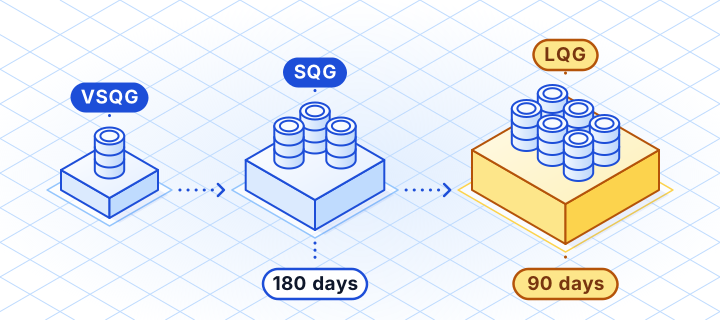
Crossing from SQG to LQG triggers 30+ new requirements, and the clock drops from 180 days to 90. Side-by-side breakdown of every storage, training, manifest, and reporting difference.
On this page
SQG vs LQG requirements determine which rulebook your hazardous waste program follows: accumulation time, on-site quantity limits, inspections, training records, contingency planning, biennial reporting, e-Manifest duties, and manifest exception reporting.
This guide compares Small Quantity Generator (SQG) and Large Quantity Generator (LQG) requirements under EPA’s generator-category rule, with a practical focus on what changes when a facility crosses the threshold. That is where compliance failures happen: a high-volume month can trigger LQG deadlines and documentation duties immediately.
Unsure of your status? Use our Generator Status Classifier to input your monthly waste volumes and get an instant, plain-English classification.
How Generator Classification Works
The EPA classifies facilities into three generator tiers based on the volume of hazardous waste generated in a single calendar month. Classification is not based on annual totals or facility size. The categories below are drawn from EPA’s generator-category table:
| Generator Category | Monthly Non-Acute Waste | Monthly Acute Hazardous Waste | Monthly Acute Spill-Cleanup Residue | On-Site Accumulation Cap |
|---|---|---|---|---|
| VSQG | 100 kg or less | 1 kg or less | 100 kg or less | 1,000 kg non-acute (no fixed time limit federally) |
| SQG | >100 kg to <1,000 kg | 1 kg or less | 100 kg or less | 6,000 kg non-acute; 1 kg acute |
| LQG | 1,000 kg or more | More than 1 kg | More than 100 kg | No general cap for ordinary waste; time limits apply |
VSQG stands for Very Small Quantity Generator. It is included here for threshold context; the requirement-by-requirement comparison below starts with SQG.
The Non-Acute vs. Acute Hazardous Waste Distinction
A critical and frequently misunderstood classification trigger is acutely hazardous waste. Under EPA’s generator-category table, a facility that generates only 50 kg of standard hazardous waste in a month may still be regulated as an LQG if it simultaneously generates more than 1 kg of acutely hazardous waste or more than 100 kg of acute hazardous waste spill-cleanup residue.
Acutely hazardous wastes include:
- P-listed wastes: discarded commercial chemical products identified as acute hazardous wastes under EPA’s P-list rule, such as sodium cyanide (P106), arsenic trioxide (P012), and nicotine (P075).
- Certain F-listed wastes: including F020, F021, F022, F023, F026, and F027, which are listed as acute hazardous wastes from specific manufacturing processes under EPA’s F-list rule.
A facility may think it is safely within SQG territory because its non-acute hazardous waste remains below 1,000 kg, but more than 1 kg of P-listed waste in the same month can move it into LQG status. The practical takeaway: track acute waste separately and review all three generator thresholds each month, especially during lab cleanouts, expired-chemical disposal, or spill response.
Key Requirement Differences: SQG vs. LQG
1. On-Site Accumulation Time
This is the most critical operational difference between the two statuses:
- SQG: May accumulate hazardous waste on-site for up to 180 days without a formal storage permit. If the nearest appropriate Treatment, Storage, and Disposal Facility (TSDF) is more than 200 miles away, the SQG accumulation rule extends this to 270 days.
- LQG: Must generally ship hazardous waste off-site within 90 days under the LQG accumulation rule. A limited 30-day extension can be granted only for unforeseen, temporary, and uncontrollable circumstances; otherwise, day 91 can convert your accumulation area into an unpermitted storage facility in the eyes of the EPA.
The accumulation clock starts the moment the first waste is placed into a container in a Central Accumulation Area (CAA). In a Satellite Accumulation Area (SAA), the clock does not begin until the SAA volume limit (55 gallons of non-acute hazardous waste, 1 quart of liquid acute hazardous waste, or 1 kg of solid acute hazardous waste) is exceeded. At that point, you have 3 calendar days to transfer the excess to a CAA or designated facility and begin the countdown. Refer to our RCRA 90-Day Rule guide for a full breakdown of when the clock starts.
2. On-Site Accumulation Quantity Limits
Beyond the time dimension, SQGs face a hard mass cap that LQGs do not:
- SQG: Cannot exceed 6,000 kg of non-acute hazardous waste or 1 kg of acute hazardous waste on-site at any time under the SQG mass cap. These limits apply to the entire facility, not per container or per accumulation area.
- LQG: The LQG accumulation rule does not list an absolute mass cap for ordinary hazardous waste accumulation, but the 90-day accumulation clock still applies.
For growing manufacturers or facilities undergoing expansions, the SQG mass cap can be a sleeper violation. A facility managing dozens of drums across multiple buildings can approach 6,000 kg faster than manual spreadsheets can catch.
3. Personnel Training Requirements
- SQG: Employees must be “thoroughly familiar” with proper waste handling and emergency procedures relevant to their responsibilities. Training can be on-the-job, and formal written training records are not strictly mandated under federal rules. However, states may impose stricter requirements.
- LQG: Formal training is mandatory. Employees must complete a structured training program that covers all relevant emergency response duties. Crucially, LQGs must maintain written training records for current personnel until closure of the facility, and for former employees for three years after they leave. Annual refresher training is required. Failure to maintain these records is one of the top violations found during EPA inspections.
4. Emergency Planning and Contingency Plans
- SQG: Must have basic preparedness and prevention measures in place. These include maintaining communication equipment, maintaining aisle space for emergency access, attempting arrangements with local responders, and posting emergency coordinator and response information.
- LQG: Must maintain a full, written Contingency Plan. This plan must:
- Be submitted to local emergency responders (police, fire, emergency response teams, hospitals, and state or local emergency response teams).
- Identify and list all emergency equipment on-site.
- Include facility response actions, arrangements, emergency coordinators, equipment, and evacuation planning.
- Include a Quick Reference Guide that emergency responders can access during an incident, including waste types, associated hazards, estimated maximum quantities, and facility maps showing where hazardous wastes are generated, accumulated, and treated.
- Be reviewed and immediately amended when facility operations, personnel, equipment, or circumstances change in a way that affects its accuracy.
Maintaining an accurate Quick Reference Guide manually is a major pain point for LQGs: the document becomes stale the moment a new drum is created, a container is shipped, or an accumulation area is relocated. Hazardous waste management software that maintains a live inventory keeps this data current automatically.
5. Inspection Requirements
- SQG: Must perform weekly inspections of central accumulation areas. The federal text specifically requires looking for leaking containers and deterioration caused by corrosion or other factors; strong inspection programs also check closure, labels, aisle space, and corrective actions.
- LQG: Also subject to weekly inspections of all CAAs. LQGs have additional requirements if they use tanks rather than containers because the LQG rule incorporates tank standards from Part 265.
Failing to document an inspection (even if the inspection occurred) can leave the facility without audit-ready evidence that the weekly inspection duty was met. This is the kind of preventable record gap that turns a small storage-area miss into a larger inspection problem.
6. Labeling and Container Management
Both SQGs and LQGs must label CAA hazardous waste containers under the SQG and LQG container-labeling rules with:
- The words “Hazardous Waste”
- An indication of the hazards (e.g., “flammable,” “corrosive,” “toxic”)
- The Accumulation Start Date
Before off-site shipment, the pre-transport marking rule also requires generators to mark transport containers of 119 gallons or less with generator information, the manifest tracking number, and EPA hazardous waste numbers.
The Danger of “Generator Status Creep”
The biggest compliance risk for SQGs is status creep: temporarily crossing into LQG territory due to a facility cleanout, chemical spill, or production surge.
If your facility normally generates 800 kg per month but a one-time cleanout generates 1,100 kg, you are an LQG for that calendar month under the monthly generator-category determination rule. During that month:
- All waste generated must be managed under the 90-day LQG accumulation limit, not the 180-day SQG limit.
- All LQG training, inspection, and contingency plan requirements apply.
- The EPA does not offer a general grace period for “accidental” LQG classification outside the episodic generation standards.
The Episodic Generation Exemption
The Hazardous Waste Generator Improvements Rule (GIR) created a formal mechanism to manage temporary spikes: the Episodic Generation Exemption. Under this provision, a VSQG or SQG that experiences a discrete event that temporarily exceeds its normal generator threshold may maintain its lower regulatory status, provided it complies with strict conditions. For SQGs, those conditions include:
- The event must be a discrete planned or unplanned episodic event that does not normally occur during generator operations.
- The episodic waste must be tracked separately from routine waste with documented start and end dates.
- The episodic waste must be shipped off-site within 60 days of the event beginning.
- The facility is limited to one episodic generation event per calendar year (with a second event available by petition to the state agency).
SQGs must notify EPA or the authorized state agency at least 30 days before a planned event, or within 72 hours after an unplanned event. Failure to properly document or notify forfeits the exemption, and the facility is reclassified upward for that month.
2025–2026 Digital and Reporting Mandates
Compliance requirements are not static. The following mandates have significantly expanded the administrative burden for both SQGs and LQGs in recent years.
Mandatory e-Manifest Registration
As of January 22, 2025, both SQGs and LQGs are legally required to maintain a registered account in the EPA’s RCRAInfo e-Manifest system. This is not optional.
The e-Manifest system tracks the cradle-to-grave movement of hazardous waste shipments electronically, replacing the traditional paper manifest process. Under this mandate:
- LQGs and SQGs must maintain an account with appropriate permissions to access final signed manifests, submit post-receipt data corrections requested by regulators, and submit electronic exception reports beginning December 1, 2025.
- Generators may still use paper manifests where allowed, but receiving facilities submit completed manifest data to e-Manifest.
- Receiving facilities are no longer required to mail paper copies of signed manifests back to LQGs and SQGs; registered generators are responsible for retrieving their final signed manifest from the RCRAInfo portal.
To register, visit the EPA’s official e-Manifest User Registration page and complete the identity proofing process through the EPA’s CDX (Central Data Exchange) system. Once registered, you can access the live system at RCRAInfo.
VSQGs are currently exempt from this registration requirement, which further underscores why SQGs and LQGs face a higher compliance burden.
The hazardous waste manifest guide covers the form, who signs it, and what to keep.
The 45/60-Day Manifest Exception Reporting Rule
Shipping waste off-site does not end your liability. After each shipment:
- For LQGs (two-step): If the signed manifest return copy from the TSDF is not received within 45 days, the LQG must contact the transporter and/or TSDF to determine the waste’s status. If the signed copy is still not received by 60 days, the LQG must file a formal Exception Report with the EPA Regional Administrator via RCRAInfo. Beginning December 1, 2025, EPA no longer accepts mailed paper Exception Reports from LQGs.
- For SQGs (single-step): If the signed manifest return copy is not received within 60 days, the SQG must file an Exception Report directly. Beginning December 1, 2025, that report must be submitted electronically via RCRAInfo. There is no intermediate LQG-style contact requirement for SQGs; the obligation triggers at 60 days.
For LQGs, the Exception Report must include a legible copy of the manifest and an explanation of the steps taken to locate the waste. For SQGs, the report is a legible manifest copy with an indication that confirmation of delivery was not received. Tracking these rolling deadlines across multiple concurrent shipments using a spreadsheet or whiteboard is an extremely high-error process. Each missed Exception Report is itself a RCRA violation.
Generator Re-Notification (Form 8700-12)
Under the GIR, all SQGs must re-notify the EPA every four years using the EPA Site ID Form 8700-12 (the RCRA Subtitle C Site Identification Form). The most recent major deadline was September 1, 2025. The next deadline is September 1, 2029.
LQGs must also re-notify by March 1 of each even-numbered year. An LQG may submit this re-notification as part of its Biennial Report.
Failing to re-notify does not reduce your regulatory burden; it adds a violation on top of your existing obligations and can create downstream manifest processing and TSDF acceptance problems.
Biennial Reporting (LQG Only)
LQGs and permitted TSDFs must submit the National Biennial RCRA Hazardous Waste Report (EPA Form 8700-13A/B) every two years. The federal biennial-report rule covers generator activity during the prior odd-numbered calendar year and sets a March 1 due date in the following even-numbered year.
- The most recent federal deadline was March 1, 2026, covering waste generated in calendar year 2025.
- The next federal deadline is March 1, 2028, covering waste generated in calendar year 2027.
- The report must account for the nature, quantities, and disposition of reportable hazardous waste generated at the facility.
- Exempt waste streams, including Universal Wastes and hazardous waste pharmaceuticals, do not count toward total generator volume under EPA’s counting exclusions and should not be included in the standard Biennial Report.
- Authorized states may impose stricter or more frequent reporting than the federal biennial schedule, so facilities should verify state-specific reporting requirements before relying on the federal default.
SQGs are not required to file the federal Biennial Report unless they were an LQG for at least one month of the odd-numbered reporting year under the biennial-report rule, although they must be prepared to produce waste records on demand during inspections.
The Financial Stakes: Why Classification Accuracy Matters
Generator status errors can create multiple independent violations: missed accumulation deadlines, missing training records, unlabeled containers, late exception reports, and defective manifests. Effective January 8, 2025, maximum civil penalties for RCRA violations increased to $124,426 per day, per violation under 42 U.S.C. 6928(a)(3) and $93,058 under 6928(g).
Tool Tip: Small generators get fined too. Browse penalties at facilities listed as small quantity generators in our RCRA Penalty Explorer.
Common scenarios where misclassification creates direct financial exposure:
| Scenario | Potential Violation |
|---|---|
| SQG ships waste on day 185, unaware it is past the 180-day limit | Storage time limit violation |
| SQG’s facility-wide mass exceeds 6,000 kg | Accumulation quantity violation |
| LQG’s training records are incomplete or not retained | Training recordkeeping violation |
| LQG’s contingency plan is outdated or not submitted to local responders | Emergency planning violation |
| Either SQG or LQG not registered in e-Manifest | Digital mandate violation |
| LQG fails to contact the transporter/TSDF by day 45 or file an Exception Report by day 60 | Manifest tracking violation |
A facility found to have systemic tracking failures, meaning an inspector can demonstrate that violations are not isolated but reflect a pattern, faces significantly compounded penalties and potential referral to the Department of Justice for criminal enforcement.
SQG vs. LQG: Full Side-by-Side Comparison
| Requirement | SQG | LQG |
|---|---|---|
| Monthly generation threshold | >100 kg to <1,000 kg non-acute; ≤1 kg acute; ≤100 kg acute spill-cleanup residue | ≥1,000 kg non-acute; >1 kg acute; or >100 kg acute spill-cleanup residue |
| On-site accumulation time | 180 days (or 270 if TSDF >200 miles) | 90 days; limited 30-day extension possible for qualifying circumstances |
| On-site mass cap | 6,000 kg non-acute; 1 kg acute | No general cap for ordinary waste |
| Training | Basic familiarity required; less formal | Structured program, annual refreshers, written records |
| Inspections | Weekly CAA inspections | Weekly CAA inspections; tank standards incorporated separately |
| Emergency coordinator | Must be designated and reachable | Must be designated and physically on-site or on-call at all times |
| Contingency plan | Basic preparedness procedures + emergency information posting | Full written Contingency Plan submitted to local emergency responders |
| e-Manifest | Registration required (since Jan 22, 2025) | Registration required (since Jan 22, 2025) |
| Manifest exception reporting | Exception Report by 60 days (single-step) | Contact transporter/TSDF at 45 days; Exception Report by 60 days (two-step) |
| Biennial Report | Not required unless LQG for at least one reporting-year month | Required by March 1 of the following even-numbered year |
| Re-notification | Required every 4 years (Form 8700-12) | Required by March 1 of each even-numbered year, often with Biennial Report |
| Episodic generation exemption | Available | Not available (already LQG) |
| Record retention | Manifest/report retention generally minimum 3 years | Manifest/report retention generally minimum 3 years; training records for former employees: 3 years after departure |
Conclusion
Generator status is not a bureaucratic label. It is the operating foundation of your entire hazardous waste compliance program. Whether you are an SQG with a 180-day clock or an LQG with 90 days, the margin for error has never been smaller. The combination of rising civil penalties, mandatory e-Manifest participation, and enhanced contingency planning requirements under the Generator Improvements Rule means that the manual tracking methods of the past are no longer adequate.
Understanding which category you are in, why it might change, and what each status requires of you is the first step. The second step is building systems that track and enforce those requirements automatically.
Regulatory Sources & References
- Official Citation: 40 CFR § 262.13 - Generator category determination
- Official Citation: 40 CFR § 262.16 - Conditions for exemption for a small quantity generator
- Official Citation: 40 CFR § 262.17 - Conditions for exemption for a large quantity generator
- Official Citation: 40 CFR § 262.15 - Satellite accumulation area regulations
- Official Citation: 40 CFR § 262.18 - EPA identification numbers and re-notification
- Official Citation: 40 CFR § 262.32 - Pre-transport container marking
- Official Citation: 40 CFR § 262.40 - Recordkeeping
- Official Citation: 40 CFR § 262.41 - Biennial reports
- Official Citation: 40 CFR § 262.42 - Exception reporting
- Official Citation: 40 CFR Part 262 Subpart L - Episodic generation
- Official Citation: 40 CFR Part 262 Subpart M - LQG emergency planning
- Official Citation: 40 CFR § 19.4 - Civil monetary penalties
- EPA Guidance: e-Manifest User Registration
- EPA Guidance: Frequent Questions about e-Manifest
- EPA Guidance: Biennial Hazardous Waste Report
- EPA Guidance: Hazardous Waste Generator Improvements Rule Summary
- EPA System: Access RCRAInfo e-Manifest
Frequently asked questions
What is the difference between an SQG and an LQG?
Small Quantity Generators (SQGs) generate between 100 kg and 1,000 kg of non-acute hazardous waste per month. Large Quantity Generators (LQGs) generate 1,000 kg or more of non-acute hazardous waste per month, more than 1 kg of acutely hazardous waste, or more than 100 kg of acute hazardous waste spill-cleanup residue in any month.
What is the storage time limit for an SQG?
Small Quantity Generators can store hazardous waste on-site for up to 180 days (or 270 days if the nearest appropriate treatment, storage, or disposal facility is more than 200 miles away) without a permit under federal SQG accumulation rules.
What is the storage time limit for an LQG?
Large Quantity Generators must generally ship hazardous waste off-site within 90 days of the accumulation start date under federal LQG accumulation rules. A limited 30-day extension may be granted only for unforeseen, temporary, and uncontrollable circumstances.
Does my facility need to register for the EPA e-Manifest system?
Yes. As of January 22, 2025, both SQGs and LQGs are legally required to maintain a registered account in the EPA's RCRAInfo e-Manifest system with Site Manager or e-Manifest Certifier permissions. VSQGs are currently exempt.
What is the penalty for violating RCRA storage time limits?
As of January 8, 2025, civil penalties for RCRA violations can reach $124,426 per day, per violation under 42 U.S.C. 6928(a)(3), or $93,058 under 6928(g). A single drum left on-site past the applicable accumulation deadline can trigger tens of thousands of dollars in fines.
What happens if my facility temporarily generates LQG amounts as an SQG?
If your facility exceeds the 1,000 kg/month non-acute threshold, the 1 kg acute threshold, or the 100 kg acute spill-cleanup residue threshold during a cleanout or spill, you are reclassified as an LQG for that month and must follow all LQG rules, including the 90-day storage limit, unless you properly use the federal episodic generation provisions or a more stringent authorized state rule applies.
What is the SQG re-notification requirement?
Under the Hazardous Waste Generator Improvements Rule, SQGs must re-notify the EPA of their generator status every four years using EPA Site ID Form 8700-12. The most recent deadline was September 1, 2025. The next is September 1, 2029. LQGs must re-notify by March 1 of each even-numbered year, usually as part of the Biennial Report.
Do SQGs have to file Biennial Reports?
Generally no. Federal Biennial Reports (EPA Form 8700-13A/B) are required from Large Quantity Generators and permitted Treatment, Storage, and Disposal Facilities (TSDFs). An SQG must report if it operated as an LQG during at least one month of the odd-numbered reporting year, and some states impose stricter reporting.
What is the manifest exception reporting rule for LQGs?
If an LQG does not receive a signed manifest copy from the TSDF within 45 days of the date the waste was accepted by the initial transporter, it must contact the transporter or TSDF to determine the shipment status. If still unresolved by 60 days, the LQG must file a formal Exception Report electronically via RCRAInfo. SQGs have a simpler rule: if the signed copy is not received within 60 days, they must file an Exception Report directly; there is no intermediate contact requirement.
What is the difference between a Satellite Accumulation Area and a Central Accumulation Area?
A Satellite Accumulation Area (SAA) is a small accumulation point at or near the point of generation, capped at 55 gallons of non-acute hazardous waste, 1 quart of liquid acute hazardous waste, or 1 kg of solid acute hazardous waste. No time limit applies in an SAA until the volume limit is exceeded. A Central Accumulation Area (CAA) is an on-site accumulation area where the 90-day (LQG) or 180-day (SQG) clock begins when the first waste is placed in a container.